Showing posts with label politics. Show all posts

Friday, 12 June 2015

Greece: it's the history, stupid.

Acropolis, c 600 BC
I'm sure you're all so used to the unending 'Greek crisis' you'd be forgiven for never wanting to hear another word about it. I went to Greece last month, having never been before, with the aim of leering at archaeological remains, rather than anything political, so I was surprised when one led me to think about the other quite differently. The first thing that struck me in Greece was the amazing oldness of the place. We all know ancient Greece existed prior to the Roman Empire. What I hadn't understood was that 'ancient' Greece was actually the last flourishing of a culture that really started a couple of millennia before, and was, by the time of the Romans, almost past its sell-by date.

Women drivers, c 1600 BC
Classical Athens was already in decline by the time the Romans arrived (overstretched on foreign wars, apparently), and Athens itself had risen to predominance after Myceanean and Minoan cultures on the Aegean Islands collapsed as a result of volcanic eruptions. At the time of the eruption, in about 1600 BC, Minoan civilisation was in full swing, and had been for some time. At the time we were paddling dugout canoes through the marshes of Britain, Minoa had a large trading fleet, actual hairstyles, towns of 100000 inhabitents, and genuine flushing toilets. I know, I know.

Anyway, once you've got past the Minoans, any museum in Greece then proceeds to confront you with a bewildering list of people who have at some point invaded or attempted to invade. The Persians, the Romans, the Crusaders, the Turks, the Venetians, and last and most recently, the Germans. Working one's way up through the local history museum in Heraklion, Crete, one starts with the local, ancient culture, and wades upwards through all these visitors, before you get to the bit about the German occupation in World War Two, which is the most unambiguously angry museum display I have ever seen.

Having overdosed on museums, I decided to head to the beach, and randomly picked somewhere on the South Coast I could get to by bus. It turned out that Sfakia port was the place where the Allies evacuated their forces as the Germans took over Crete in 1940. Lesson one of Greece: there's no getting away from history, anywhere, ever. I walked up the hill and found this: a shrine built around the skulls of villagers who were shot for aiding the escape of Allied stragglers. They are not replicas, or art, but the actual skulls, and you can see where they have been smashed by bullets. The atmosphere in the vicinity was creepy and oppressive: I backed out in a hurry.

Of course, one might say that the Greeks should get over this, like the rest of Europe has got over war, fascism, and communism, etc. In some ways, it has: the town was crawling with German tourists who seemed unbothered by the stacked, smashed bones. Nonetheless, when you see how the time frame of Greece is a bit different to other places, you realise that to the Greeks, with 4000 years of civilisation on your doorstep, something that happened 70 years ago is really very recent, and why it might be a bit well - insensitive - to turn up, after all that sort of thing, and start trying to order people around. 

All this history helped me understand why Alex Tsipras and Syriza think they can see off the EU and its ghastly austerity plans. Although Greece has been taken over by foreign powers dozens of times, they have, in the end, always left. Greece's history has been marked by multiple invasions, multiple collapses, and repeated tragedies. Ancient Greece invented tragedy, and they aren't above playing one. Perhaps Tsipras doesn't think of himself as a modern, managerial type of politician, always finding the neat compromise with an eye to his career, he thinks he's handling some bloody last stand on a hilltop. Perhaps, in a way, he's right.

If you think that this is a fight about debt repayment, or about one or two percent of GDP, you are missing the point. Whether they owe the money or not is a irrelevance, a red herring. This is a fight about autonomy, and maybe about honour. What matters for the Greeks is that they exist as an entity with meaning, a small country with a culture and self-determination, or get subsumed into some larger, faceless thing.

I'm fairly sure that's actually what the EU think it's about as well. The EU and its Austerity-bureaucrats think they're the Romans, subduing a rebellious province. They think they're ensuring the onward march of civilisation, and saving the Empire from ruin. I think the Greeks think a bit like this too: except in their version they are the defenders of civilised society, holding out for democracy, against the Philistines of Rome. 


Library cuts in Athens. If you didn't return your scroll in time, your fine is now 21,850,678 denarii, or enough to clear the entire Greek debt.

Saturday, 6 April 2013

Headlines, reality, and how people get confused.

Dear all, I have been finding the internet a little trying this week. What I mean is, I have been finding Twitter a little trying, for a very specific reason. It's the same reason that's made me bang my head on the table on previous occasions, and my annoyance levels are now at a scale where I am being forced to rant about it, longhand, so to speak.

If you are not in the UK, bear with me. (I am sure you can find equivalent examples from your own country.) Earlier this week there was a court case in which a man was convicted of killing six children (his own) in a fire. A newspaper, which I will not link to, wrote a headline blaming this on the benefits system. Many people were very angry, because the government is currently in the middle of massively reducing benefits for all kinds of poor people, both in work and out, while giving away tax cuts to the rich.

I should point out that this twitstorm was the second twitstorm of the week. The first was when a cabinet minister (weekly pay £1800 approx) claimed he could live on £53 a week, like an unemployed person. Within hours a petition to make him do so had been signed by quarter of a million people.

Now, in my opinion his comments were plainly stupid, as was the headline. What I find bizarre is that so often on the internet, the levels of outrage over what was said massively exceeded the levels of outrage over what was done.

Now, I know we're all getting used to the new in internet age and all, but I think some people have a reality problem. I am a writer and I spend a lot of time thinking about what is written on the page in front of me. I spent hours every day in the company of people who only exist in my own head, and on the page, in front of me. Then, at a certain point, I pack up my laptop, get on my bicycle (real) cycle home through the city (real) to the house that I live in (real). Sometimes in the evening I chat to people on twitter. They are also real (although possibly, some of them are not quite what they claim to be). These things, the bicycle and the city and the house and the people who tweet at me will all continue to exist as and when I shut off the laptop and close down twitter.

But I think some people are confused. They think that these things which are written down, in newspapers and on Twitter, are the real things. I'm not denying that there is a connection between the two, and that one influences the other - I am a writer, after all. But however bad a headline is, it is still words printed on paper, and those six children are still dead. When Reeva Steenkamp was killed, a British paper printed a photo of her, in her bikini, on its front cover. Another newspaper - which was, in print, relaying every salacious detail of the case - wrote about how terrible it was. Many many people exercised a great deal of affront over this photograph, which was of a woman who had consented, while alive, to have this photograph published. Far, far more people seemed upset about the photograph, than about the fact that she was dead. Does this make sense? If I had a choice of having a bikini photo of me (I'd look a lot worse than she did) on the front page of a newspaper, or being dead, I'd choose being exposed, in all my white, wintry flabbiness, on the front of a newspaper. After all, it'd pass after a bit, and I'd get on with whatever I was doing. Which I couldn't, if I was dead. Like those six children are.

Equally - to go back to Steenkamp - the levels of outrage over this death were pretty extensive on twitter. South Africa has a murder rate of 15,940* in the most recent year I can see figures for, or a figure of 31.8 per 100,000 inhabitants, compared to an average of 1 for western Europe. I cannot see how many of those victims were women, but let us say, for the sake of argument, around a third. So maybe 5000 South African women died in the last year, by murder. Because they did not die at the hands of someone famous, we have never heard of it. And yet, it still happened.

The fact is, sometimes truth is in statistics, and not in headlines. Five thousand dead women is so much very worse than one dead woman, and yet we find it much harder to relate to. Sometimes the things that we should care about are hidden inside numbers, not in a single photograph or inflammatory headline. Sometimes, the really truly awful things are not written down at all, because no-one bothered to catalogue, count, or even notice them.

So next time you find yourself inclined to go off on one about some tabloid headline, take a deep breath and ask yourself a few questions. Remember, for a start, that the purpose of headlines is to provoke shock and outrage, and that the person who writes that headline is a skilled professional, with long experience of doing so. Second, ask yourself, is that the debate I want to have? After all, the person setting the question has so much more power than the person who can only answer it. And then, perhaps, ask yourself, what is NOT being discussed here? And think about what you would like to see questioned and addressed, and perhaps start the conversation again, your way, because if you keep on just reacting you won't have any time or energy to act, which is actually what needs to happen.


* All figures from here


Monday, 21 January 2013

Borgen, and Other Kinds of Stories.

Saturday night, I watched Borgen on BBC4. I can't even begin to describe how much I love Borgen. In case you haven't watched or don't get it: it's a TV series, in Danish, about a fictional Prime Minister, Birgitte Nyborg, her spin-doctor and his journalist girlfriend. A typical episode will kick off with Birgitte wondering who to dispatch to Brussels to be Danish representative in the EU. It sounds so tedious you think of turning off entirely. Then somehow, 50 minutes later, you're screaming, Noooooooo, Birgittte! at the TV, have spilt beer down the sofa, and are possibly blubbing hopelessly.

It is, as well as being exceedingly good, all exceedingly Scandinavian.

I was thinking about this the other night when I'd gone to the cinema. I was sitting in there, waiting for the movie, and the trailers came on. Normally I like this bit. Anyway, the trailers started. I can't even remember what they were for, just what I thought as they rolled away. 'An American story', I thought, and then the same thing, and then the same thing again. There was something with lots of explosions, a man wrongly accused of an air crash and a film about Lincoln. And I felt like I'd seen them all, already.

Now, to be clear, I have nothing against a story told by Americans, made by Americans, with Americans in it. What I mean is the type of narrative, the underlying story which drives the thing along.

Personally, as somebody who writes stories, I think that stories are massively important to people. They help people make sense of the world around them. They also influence people in fundamental ways, in teaching them what is important, their place in the universe, and how they should deal with people.

Man with Gun: So very 20th Century
Now, regardless of genre, there is one story that Hollywood loves telling, over and over again. Hollywood grew up and boomed as America did, in the first half of the 20th Century. For years, it made films about how a man strode out into wilderness, defeated evil and brought home the lady. It still does, in a way. In the classic American narrative, one man (be he a soldier, president or explorer) goes out, and through his courage, strength and moral righteousness, saves the day.

It's not like the Americans are the only country whose films mirror their national obsessions. British films are often about class, French films are often about sex. The most successful German films in recent years have been about moral redemption from dictatorship and political excess: the only South African film to have been internationally successful is a comedy about conflict between species. It's just that the Americans have a larger and better-funded film and TV industry than the rest of these countries, and that's why, often, you're watching an American narrative, with all this entails.

Tired-looking woman making compromises: so very 21st Century.
Birgitte Nyborg is not like an American hero. She is the head of a shaky coalition government that is permanently on the verge of falling apart. Borgen would different if it was an American series. Probably, there would be a terrorist threat to Denmark, and Birgitte Nyborg would save the nation, in some kind of dramatic way. In the actual series, Birgitte never saves Denmark from anything. She spends too much time in an office, wrangling and shouting at people. She doesn't even always succeed: in one episode she undermines an ally to make him more compliant, only to find he has resigned and tipped the entire government into crisis. Her personal life falls apart: her husband leaves her, and her daughter has panic attacks.

And yet, I think this is why people like her. She is, in the end, like us: she lives in an ordinary house and struggles, on a daily basis, to do the right thing in trying, contradictory circumstances. She isn't always terribly ethical, and she isn't always right or successful. But unlike many of the politicians in the real world, she does have one redeeming quality, which is that she does actually care. Also, she keeps on caring, and trying to sort it out, long past the point where most of us would have thrown in the towel. And for that, she is a hero, and you're left in no doubt of it.

The thing is, she is a hero of a different kind. She doesn't ever stride out into the desert, or do anything alone. She is part of a web of people, some helpful, some compliant, some absolutely mad or malign. And this, this web of interdependence, is the thing that you will never see in an American story. And it was as I was sitting there, in the cinema, that I thought of how very very bored I was of seeing that same old story, played out again and again.

Tuesday, 8 January 2013

Enjoy Africa: But Please Remember It's Fiction.


If you are in the UK you will probably have watched the BBC's latest wildlife extravaganza, 'Africa'. The BBC Wildlife Unit is based in Bristol, where I live. Generally, they make excellent programs, but I feel a bit uncomfortable about this particular series.

First of all, the title. Let's get this straight: 'Africa' is not a wildlife reserve. Neither is it, as a BBC announcer commented, 'the world's largest wilderness'. It is a continent of 1 billion human beings, 57 countries, and countless cities, towns and villages. There are roads and railways. There are ports and supermarkets and TV stations and football teams and nightclubs and all the things that happen where there are human beings.

Throughout the nineteenth century, when Africa was being colonised, there was an idea of it as 'the dark continent'. It was an empty space, populated by wildlife and – depending on your preference – either degraded, semi-human populations, or by noble savages. It was a blank canvas, on which the Europeans could draw their fantasies.

A series like 'Africa' seems to me a very modern, beautifully shot version of those fantasies. A pristine, mysterious landscape, full of nature, red in tooth and claw. In the first episode, Kalahari, there was not one sign of a human in the landscape. 

 Fig 1. What wildlife filmmakers think Africa looks like.

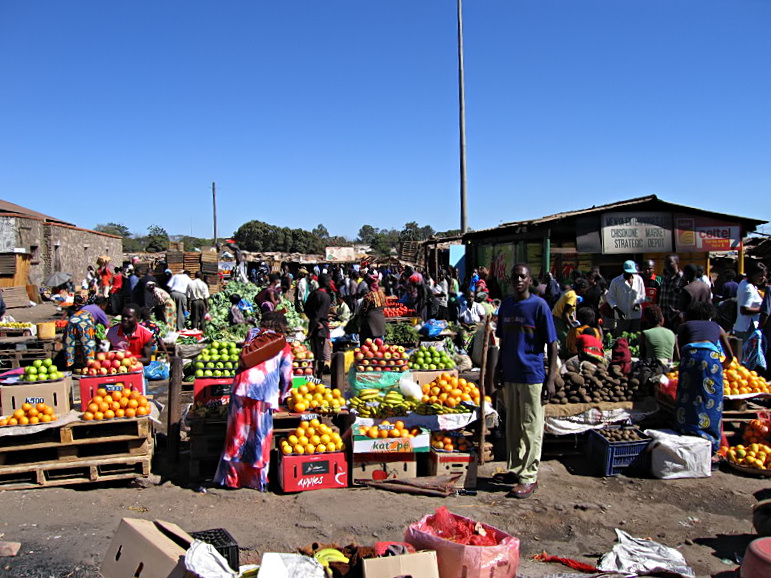
Now, I am lucky and privileged enough to have been to Africa. I can tell you from my own experience that this is not the normal condition. Vast tracts of Africa are farmed, either locally, by subsistence farmers, or intensely. Even in those areas which are unfarmed, you will not go far without running into humans or their activities: beehives made out of hollow logs, hung in the trees; people herding cows or fishing or gathering wood, selling grilled corn by the roadside, or simply walking from A to B, to visit relatives, or to the church or pub.

This is not a tragedy. It is simply reality. In some places this is a beautiful, peaceful thing, in others people look worn and angry. But in very few places, is the continent naturally empty. Those shots you see in wildlife films are taken in wildlife reserves and game parks. These are largely areas from which the people have been moved out. Not recently (that's now frowned upon) but in decades past. This is not to say that Africans resent the game parks. On the contrary, many earn their living from them. But what you are looking at is not the 'natural state' of Africa.

These humanless, pristine spaces are maintained by humans who carefully count and preserve the populations of 'megafauna' (lions, giraffes, rhino, etc) which attract tourists and yes, wildlife crews. They do this, because rich westerners who want to see a pristine wilderness pay nicely for it.

The first episode of the Africa series, Kalahari, was shot in Botswana. Botswana is lucky to be able to maintain some of the largest nature reserves in Africa for a number of reasons. Firstly, they are geographically a sizeable country, with a tiny population (2m). Secondly they have the good fortune to be sitting on the worlds largest diamond fields, the profits of which, due to the good sense of some president gone-by, are partly nationalised. It is a quiet, well-run democracy with peaceful elections and a decent standard of living.

All the same, the nature reserves of Botswana do not simply sit there. They are run by a wildlife service which maintains and guards and manages these areas. Their personnel will include civil servants and ecologists and vets and scientists and ex-military personnel who combat poachers. Most of these professionals are African. You will probably never see them in a wildlife documentary.

Other countries which maintain large nature reserves are not as lucky as Botswana. Tanzania, for example, which has huge grassland reserves, is peaceful but extremely poor, while Congo, which houses the mountain gorillas, is possessed of ample resources but plagued by warfare. Tanzania, which relies on aid for much of its income, is under intense pressure to preserve its wildlife, which wanders across vast open tracts of country ideal for poaching. I'm not saying they shouldn't. I'm just saying that I've been in a primary school in Tanzania, and there were no chairs or tables for the children to sit at, just stones on the floor. Every time you decide to spend money on one thing, you're not spending it on another.

I'm not saying these parks shouldn't be there, or that we shouldn't make wildlife programs in them. Of course these ecosystems should be preserved: they are world-class heritage sites. What concerns me is that they are presented to us, removed from the real context and place which they are in. There seems to be an unlimited appetite for wildlife footage, yet no-one  considers the daily life of the continent to be of any interest whatsoever.

The crazy thing is that Africa is one of the most fascinating places I've ever been to. It is full of little-known history, fantastic culture, food, art and music. It is full of contradiction and uncertainty, and after decades of decay and stagnation, is, in many places, bursting into life again.

Personally I'd like to challenge the BBC to make an expensive, breathlessly narrated series showing the trials and travails of Africa's most interesting species: I mean, homo sapiens. Not holding my breath for that one, though.

Fig 2: What I think Africa looks like.


Wednesday, 22 February 2012

RIP Marie Colvin

In the last few hours, Sunday Times journalist Marie Colvin has been killed* in Syria, in Homs, in shelling by the forces of Bashar Al-Assad. Colvin was one of those old-fashioned beasts, a proper war-reporter. She'd done every war since Bosnia, and lost an eye in a grenade attack in Sri Lanka. She was also, clearly, female. So what? you might say. Aren't dozens of other people, many female, dead, as well? Yes, that's why Colvin was there.

But I still think it matters. It matters if you care about knowing what's going on in the world, and it matters if you're a woman.

First, many news organisations these days are so twitchy about accusations of bias and protection of their journalists that they like to station reporters in neighbouring countries where nothing is actually happening, or endlessly obsess about negotiations at the UN while the real action happens elsewhere. This strategy does not always pay off. Last year in Libya, dozens of journalists got stuck in the Rixos Hotel in Tripoli, effectively hostages of the Gaddafi regime, parroting press releases that became more and more surreal. When rioting broke out in London, the BBC were so concerned about the safety of their journalists that they didn't even have any pictures until about an hour after the riot was underway, and were totally trumped by other stations who had (perfectly safely) obtained footage.

As Colvin herself pointed out, none of this is a substitute for actually going to where the action is really happening.

Consequently, this gap, matched with improvements in internet technology, means that the space is often filled by bloggers and citizen journalists with a mobile phone. This is no bad thing in terms of getting the truth out, but it does mean that the unfortunate person has no backup in terms of medical, legal or consular support. They have to take their chances with the local population, of which they are usually a part.

Many of these amateur news gatherers, reporters and commentators are female. The point about this is that when you are a girl, you grow up with lots and lots of injunctions about looking after your own safety. Don't do this, don't do that, or something terrible will happen to you. And this is in a peaceful, Western Society, which is, by global standards, really pretty safe. Sometimes the worst offenders behind these well-meaning injunctions are other women. The amount of ear-bashing any young woman receives about 'safety' could lead them to believe that being 'safe' is the single most important thing in life, ever.

However, a little intellectual investigation shows that safety is a pretty negative concept. You could get so anxious about safety that you never left the house, and had a heart attack on the sofa instead. In the end, safety is a false concept. There are only greater and lesser risks, and things which might or might not be worth those risks. But there are also things of greater and lesser value, and for some people, letting the world know what's happening, trying to get out news of a great wrong, is worth that great risk. It's the moment when you fight your urge to run away, to hide in the cellar, and you go back towards the noise, instead, to find out what's happening.

If you are a woman, this flies in the face of everything that you're taught. It is a deliberate repudiation of the idea that safety is the most important thing to you as female. It shows that you think truth, accuracy, curiosity, a desire for knowledge - or even your career, or the adrenaline rush - are more important than that all-nebulous, disabling thing, safety. I really believe that the moment when you choose something else over safety is the moment when you stop being a honorary child (women and children, etc) and stake your place as a fully-fledged member of the human race.

And that's why Marie Colvin was important. Female war reporters. Standing up for your right, as a woman, to do something completely frikkin' stupid, and dangerous as well. Which is a right worth dying for, in my opinion.

RIP.

Respect.

And by the way, if you are planning to follow her example, read this.


*I think 'murdered' is actually the correct term, since they were not in a military installation but a press centre next to a hospital.
** I don't have a picture because I can't find a copyright free one and I don't want to get sued by News International.

Friday, 19 August 2011

The Markets are Angry! The Markets are Angry!

The Markets are angry. They have shown their displeasure today by slumping below the FTSE 5000 mark. Yes, I know that means squit-all to most of us, but bear with me. I'll explain. The Markets are angry because we, the people, have been bad, people. That is why the Markets are angry.

And what are these Markets that are angry, you ask? Well, as any economist can explain, they are like a big giant force that sometimes does bad things to people, but they are the Markets, and the must be obeyed. There are some people who understand these Markets better than others, and know how to placate them. These people are called economists.
An Economist
But now, take a deep breath, I am about to commit heresy. I am about to blaspheme. No respectable citizen will look me in the eye. Because I am sure... that the Markets are a bunch of people!

What's that you say?

Look, the point is, ever since two shonking great wars in the 20th Century made us feel a bit iffy about Christianity, and all that 'merciful deity' malarkey, people have been feeling a bit blank. That's because humans like to believe in stuff, and they like to think that someone actually is in charge of things. It makes them feel calmer.

But some people, people, exploit this. They like to set themselves up and preach gibberish. This gibberish usually involves having to give up your money, hand over the deeds to your home, and let the perpetrators of the gibberish shag any of your family that they've a mind to. You know, like a cult. Or like, erm... anyway.

So, cults. The Romans were good at cults. They had one for pretty much whatever god you could find. The Romans were very keen on appeasing the Gods, and before they went into battle would always get a soothsayer to read the entrails, which was a sure-fire way of finding out what the Gods were thinking. Trust me, there's a bloke in Canary Wharf dissecting a pigeon to check out the latest on the oil futures, even as we speak.

Anyway so back in the year BC241 there was a Roman General by the name of Gaius Flaminius and he'd been sent off to fight. He'd manoeuvred his troops into a really good position, and his opponents into a bad one. He really fancied his chances. So he lined up his men, and read the entrails. Entrails say: go home, it'll all end in doom. Flaminius has another look at the battlefield, tells soothsayer to stuff his entrails, goes out and scores a decisive victory. And off he stomps, back to Rome, looking pretty bleedin' cheerful. What does he expect? Welcome party? Maybe some gifts of some good-looking slaves? Nope. Poor old Flaminius he gets a bollocking, and is demoted. Nobody cares that he won. Point is, he defied the entrails! And everyone knows where that leads. Disaaaaaaster!

Clearly, in 2000 years, we've got a lot more rational, right? We'd never fall under the thrall of such a lunacy.

Where was I? Oh yes, the Markets. The Gods. The priests. The Economists. Making sacrifices. Cutting up chickens. Reading the data. It must have been a nice life, being a Roman Priest. Power. Having the ineffable might of the Gods on your side.

I do feel sorry for Gauis Flaminius. Because I'm a heretic as well. I tend to think that the Markets don't really exist as some big, all powerful force that must be obeyed. I tend to think that they're just a bunch of rich people, shifting their money around. And a bunch of very well paid slaves, that do the shifting for them.

Perhaps if we remembered that we're dealing with people, not some great, unknowable force, we might be able to stem the endless need for sacrifices. Cause I for one, am fed up with our manky old soothsayers.