Dear all, I have been finding the internet a little trying this week. What I mean is, I have been finding Twitter a little trying, for a very specific reason. It's the same reason that's made me bang my head on the table on previous occasions, and my annoyance levels are now at a scale where I am being forced to rant about it, longhand, so to speak.
If you are not in the UK, bear with me. (I am sure you can find equivalent examples from your own country.) Earlier this week there was a court case in which a man was convicted of killing six children (his own) in a fire. A newspaper, which I will not link to, wrote a headline blaming this on the benefits system. Many people were very angry, because the government is currently in the middle of massively reducing benefits for all kinds of poor people, both in work and out, while giving away tax cuts to the rich.
I should point out that this twitstorm was the second twitstorm of the week. The first was when a cabinet minister (weekly pay £1800 approx) claimed he could live on £53 a week, like an unemployed person. Within hours a petition to make him do so had been signed by quarter of a million people.
Now, in my opinion his comments were plainly stupid, as was the headline. What I find bizarre is that so often on the internet, the levels of outrage over what was said massively exceeded the levels of outrage over what was done.
Now, I know we're all getting used to the new in internet age and all, but I think some people have a reality problem. I am a writer and I spend a lot of time thinking about what is written on the page in front of me. I spent hours every day in the company of people who only exist in my own head, and on the page, in front of me. Then, at a certain point, I pack up my laptop, get on my bicycle (real) cycle home through the city (real) to the house that I live in (real). Sometimes in the evening I chat to people on twitter. They are also real (although possibly, some of them are not quite what they claim to be). These things, the bicycle and the city and the house and the people who tweet at me will all continue to exist as and when I shut off the laptop and close down twitter.
But I think some people are confused. They think that these things which are written down, in newspapers and on Twitter, are the real things. I'm not denying that there is a connection between the two, and that one influences the other - I am a writer, after all. But however bad a headline is, it is still words printed on paper, and those six children are still dead. When Reeva Steenkamp was killed, a British paper printed a photo of her, in her bikini, on its front cover. Another newspaper - which was, in print, relaying every salacious detail of the case - wrote about how terrible it was. Many many people exercised a great deal of affront over this photograph, which was of a woman who had consented, while alive, to have this photograph published. Far, far more people seemed upset about the photograph, than about the fact that she was dead. Does this make sense? If I had a choice of having a bikini photo of me (I'd look a lot worse than she did) on the front page of a newspaper, or being dead, I'd choose being exposed, in all my white, wintry flabbiness, on the front of a newspaper. After all, it'd pass after a bit, and I'd get on with whatever I was doing. Which I couldn't, if I was dead. Like those six children are.
Equally - to go back to Steenkamp - the levels of outrage over this death were pretty extensive on twitter. South Africa has a murder rate of
15,940* in the most recent year I can see figures for, or a figure of 31.8 per 100,000 inhabitants, compared to an average of 1 for western Europe. I cannot see how many of those victims were women, but let us say, for the sake of argument, around a third. So maybe 5000 South African women died in the last year, by murder. Because they did not die at the hands of someone famous, we have never heard of it. And yet, it still happened.
The fact is, sometimes truth is in statistics, and not in headlines. Five thousand dead women is so much very worse than one dead woman, and yet we find it much harder to relate to. Sometimes the things that we should care about are hidden inside numbers, not in a single photograph or inflammatory headline. Sometimes, the really truly awful things are not written down at all, because no-one bothered to catalogue, count, or even notice them.
So next time you find yourself inclined to go off on one about some tabloid headline, take a deep breath and ask yourself a few questions. Remember, for a start, that the purpose of headlines is to provoke shock and outrage, and that the person who writes that headline is a skilled professional, with long experience of doing so. Second, ask yourself, is that the debate I want to have? After all, the person setting the question has so much more power than the person who can only answer it. And then, perhaps, ask yourself, what is NOT being discussed here? And think about what you would like to see questioned and addressed, and perhaps start the conversation again, your way, because if you keep on just reacting you won't have any time or energy to act, which is actually what needs to happen.
* All figures from here
Showing posts with label africa. Show all posts
Showing posts with label africa. Show all posts
Saturday, 6 April 2013


Tuesday, 8 January 2013
Enjoy Africa: But Please Remember It's Fiction.
If you are in the UK you will probably have watched the BBC's latest
wildlife extravaganza, 'Africa'. The BBC Wildlife Unit is based in
Bristol, where I live. Generally, they make excellent
programs, but I feel a bit uncomfortable about this particular series.
First of all, the title. Let's get this straight: 'Africa' is
not a wildlife reserve. Neither is it, as a BBC announcer commented,
'the world's largest wilderness'. It is a continent of 1 billion human
beings, 57 countries, and countless cities, towns and villages. There
are roads and railways. There are ports and supermarkets and TV
stations and football teams and nightclubs and all the things that
happen where there are human beings.
Throughout the nineteenth century, when
Africa was being colonised, there was an idea of it as 'the dark
continent'. It was an empty space, populated by wildlife and –
depending on your preference – either degraded, semi-human
populations, or by noble savages. It was a blank canvas, on which the
Europeans could draw their fantasies.
A series like 'Africa' seems to me a very modern, beautifully shot version of those fantasies. A
pristine, mysterious landscape, full of nature, red in tooth and
claw. In the first episode, Kalahari, there was not one sign of a
human in the landscape.


Fig 1. What wildlife filmmakers think Africa looks like.
Now, I am lucky and privileged enough
to have been to Africa. I can tell you from my own experience that
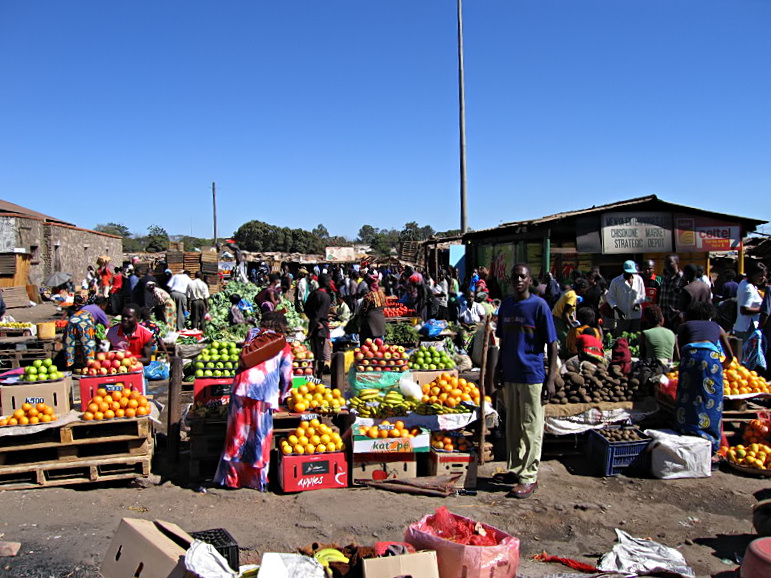
this is not the normal condition. Vast tracts of Africa are farmed,
either locally, by subsistence farmers, or intensely. Even in those
areas which are unfarmed, you will not go far without running into
humans or their activities: beehives made out of hollow logs, hung in
the trees; people herding cows or fishing or gathering wood, selling
grilled corn by the roadside, or simply walking from A to B, to visit
relatives, or to the church or pub.
This is not a tragedy. It is simply
reality. In some places this is a beautiful, peaceful thing, in
others people look worn and angry. But in very few places, is the
continent naturally empty. Those shots you see in wildlife films are
taken in wildlife reserves and game parks. These are largely areas
from which the people have been moved out. Not recently (that's now
frowned upon) but in decades past. This is not to say that Africans
resent the game parks. On the contrary, many earn their living from
them. But what you are looking at is not the 'natural state' of
Africa.
These humanless, pristine spaces are maintained by humans who carefully count and
preserve the populations of 'megafauna' (lions, giraffes, rhino, etc)
which attract tourists and yes, wildlife crews. They do this, because
rich westerners who want to see a pristine wilderness
pay nicely for it.
The first episode of the Africa series,
Kalahari, was shot in Botswana. Botswana is lucky to be able to
maintain some of the largest nature reserves in Africa for a number
of reasons. Firstly, they are geographically a sizeable country, with
a tiny population (2m). Secondly they have the good fortune to be
sitting on the worlds largest diamond fields, the profits of which,
due to the good sense of some president gone-by, are partly
nationalised. It is a quiet, well-run democracy with peaceful
elections and a decent standard of living.
All the same, the nature reserves of
Botswana do not simply sit there. They are run by a wildlife service
which maintains and guards and manages these areas. Their personnel
will include civil servants and ecologists and vets and scientists and ex-military personnel
who combat poachers. Most of these professionals are African. You
will probably never see them in a wildlife documentary.
Other countries which maintain large
nature reserves are not as lucky as Botswana. Tanzania, for example,
which has huge grassland reserves, is peaceful but extremely poor,
while Congo, which houses the mountain gorillas, is possessed of
ample resources but plagued by warfare. Tanzania, which relies on aid
for much of its income, is under intense pressure to preserve its
wildlife, which wanders across vast open tracts of country ideal for
poaching. I'm not saying they shouldn't. I'm just saying that I've
been in a primary school in Tanzania, and there were no chairs or
tables for the children to sit at, just stones on the floor. Every
time you decide to spend money on one thing, you're not spending it
on another.
I'm not saying these parks shouldn't be
there, or that we shouldn't make wildlife programs in them.
Of course these ecosystems should be preserved: they are world-class heritage sites. What concerns me is that they are presented to us, removed from the real
context and place which they are in. There seems to be an unlimited appetite for wildlife footage, yet no-one considers the daily life of the continent to be of any interest whatsoever.
The crazy thing is that
Africa is one of the most fascinating places I've ever been to. It is
full of little-known history, fantastic culture, food, art and music.
It is full of contradiction and uncertainty, and after decades of
decay and stagnation, is, in many places, bursting into life again.
Personally I'd like to challenge the BBC to make an expensive, breathlessly narrated series showing the trials and travails of Africa's most interesting species: I mean, homo sapiens. Not holding my breath for that one, though.

Subscribe to:
Posts (Atom)